GrowHab,
68 Andrew Lloyd Drive,
Doonside, NSW 2767
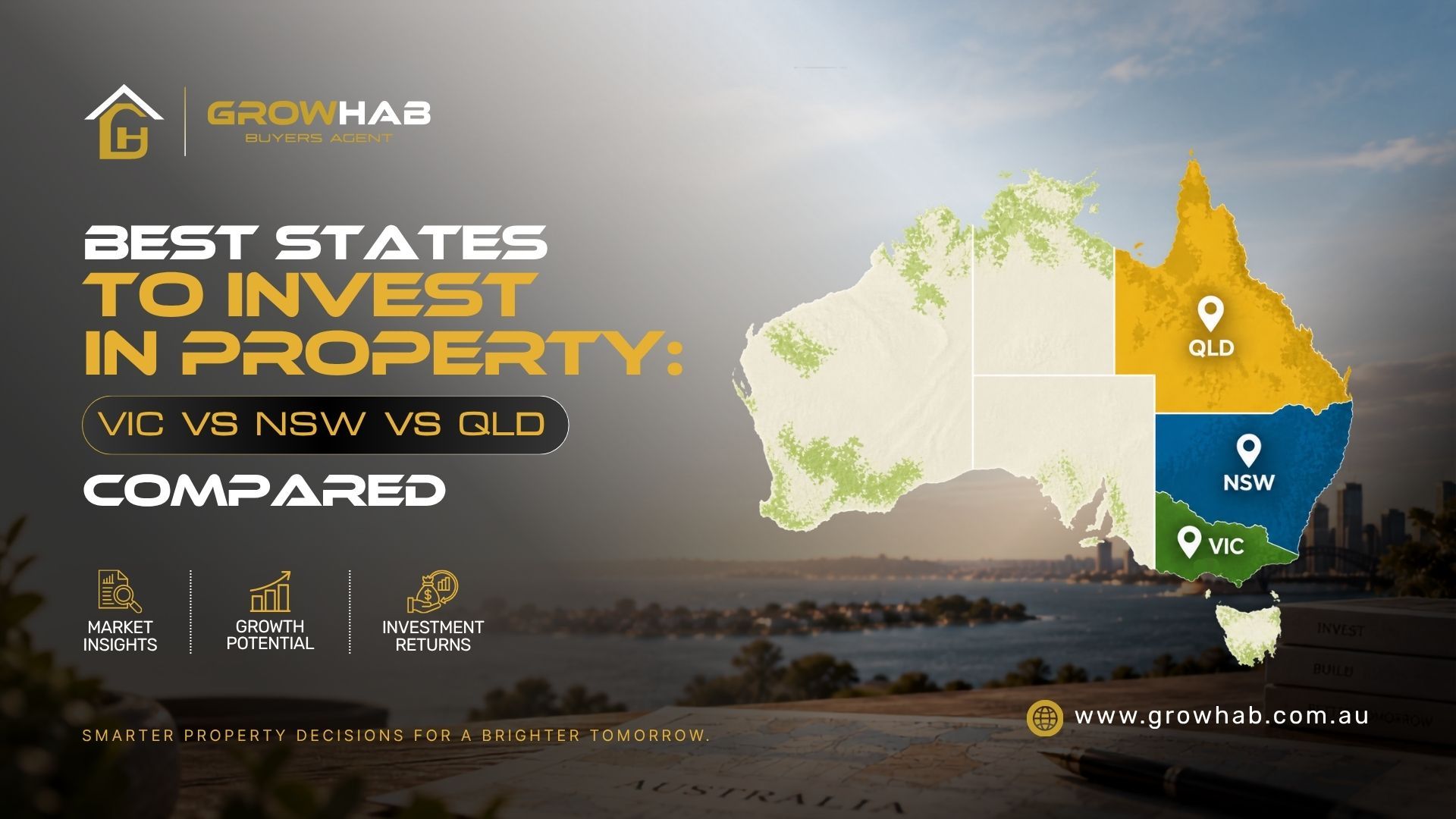
Choosing between Victoria, New South Wales and Queensland is not simply about finding the state with the highest property growth. For property investors, the better question is: which state and property market best fit your investment startegy?
Stamp duty, land tax, rental yield, capital growth, affordability, population growth and local property demand can all influence the performance of an investment property. So, before deciding where to invest, it is important to look beyond state-wide headlines and understand what is happening at the suburb and property level.
There is no single best state to invest in property for investor.
Queensland can offer attractive opportunities across Brisbane and selected regional markets, particularly where affordability, rental demand and population growth align.
New South Wales has deep and established property markets, but higher purchase prices in major locations can make entry costs and cash flow more challenging.
Victoria offers a broad mix of metropolitan and regional markets, giving investors plenty of options at different price points.
Recent property investment research also shows why state-level rankings should be treated carefully. Investment hotspots can appear across Queensland, NSW and Victoria, while individual suburbs can perform very differently from their broader state markets. Rather than asking: "Which state is best?", Investors should ask "Which property market best matches my investment strategy?"
A successful
property investment
decision requires investors to look beyond median prices and consider
property market data,
rental yield, capital growth, affordability, vacancy rates, population growth, employment, infrastructure and housing supply.
When comparing VIC, NSW and QLD, consider:
it is also important to understand how these factors work together.
For example, a property with a high rental yield may provide stronger cash flow, but that does not automatically mean it will deliver strong long-term capital growth Likewise, a high-growth market may offer attractive capital growth potential but require a larger upfront investment and produce lower rental returns. The goal is to find a balance that matches your financial position and investment objectives.
Victoria offers investors a broad mix of metropolitan Melbourne suburbs and regional property markets. This diversity means investors can find very different property prices, rental yields and growth profiles within the same state
Stamp duty is an important upfront cost for Victorian property investors. The amount payable depends on the property's value and applicable duty rates. Land tax is another consideration, particularly for investors who are building a property portfolio. The amount payable is based on the taxable value of land holdings. These costs should be included when calculating the potential return of an investment property.
Victoria demonstrates why investors should look at individual suburbs rather than relying solely on state-wide averages. Different locations can experience very different levels of buyer demand, rental demand and price growth.
Melbourne also provides investors with a wide range of established and emerging suburbs, while regional Victoria can offer different combinations of affordability, rental demand and growth potential.
For investors considering property investing in victoria the focus should be on identifying markets with strong underlying fundamentals rather than simply choosing a suburb because it has recently recorded high growth.
New South Wales contains some of Australia's most established property markets, led by Sydney and supported by a wide range of regional locations. For investors, one of the biggest considerations is balancing strong property demand with higher purchase prices and holding costs in many major markets.
Transfer duty is an important upfront expense when purchasing an investment property in NSW. Land tax is another consideration, particularly for investors building a portfolio across multiple properties. Understanding these costs before purchasing is essential because they can affect both cash flow and the overall return of an investment.
NSW should not be viewed only through Sydney's performance. Regional markets can have very different investment fundamentals, including lower entry prices, different rental yields and local economic drivers. For investors looking at property investment in NSW, the right opportunity may therefore be outside Sydney
The key is to assess the individual market based on:
The best NSW investment may not be in Sydney.
Queensland has become an important focus for real estate investing, with opportunities ranging from Brisbane and the Gold Coast to a variety of regional markets. However, investors should avoid assuming that every Queensland market will perform in the same way. The same principles apply here: identify the locations where affordability, rental demand, population growth, employment and supply fundamentals support your investment strategy.
Queensland uses a progressive transfer duty system, with the amount payable depending on the property's value and buyer circumstances. Land tax is another factor investors need to consider, particularly when building a larger property portfolio. These costs should form part of the initial investment assessment rather than being considered after purchasing the property.
Queensland offers a range of markets where investors may find a combination of rental demand, affordability and growth potential. Brisbane has attracted significant attention, while selected regional markets can offer different investment opportunities. Research has also highlighted Queensland's representation among Australian investment hotspots. However, this does not mean Queensland is automatically the best state to invest in property. It simply highlights the importance of investigating the individual markets within the
state.
| Factor | Victoria | NSW | Queensland |
|---|---|---|---|
| Major market | Melbourne | Sydney | Brisbane |
| Entry cost | Varies by market | Often higher in major markets | Varies by market |
| Rental yield | Suburb-specific | Suburb-specific | Suburb-specific |
| Growth potential | Location dependent | Location dependent | Location dependent |
| Investor opportunity | Established + regional markets | Established + selected regional markets | Metro + regional markets |
| Best approach | Compare individual suburbs | Compare individual suburbs | Compare individual suburbs |
There is no universal winner. Each state contains markets that can suit different investment strategies. The strongest opportunity may come from identifying.
Choosing a state is only the first step. Investors also need to find suitable properties within their chosen market. This is where
off-market property opportunities canbecome part of an investment strategy.
Off-market properties are not necessarily advertised broadly through the major property portals. Access to these opportunities can give investors another source of potential properties to assess. However, an off-market property is not automatically a good investment. It still needs to pass the same checks as any other property:
The right state depends on what you are trying to achieve from your investment.
If cash flow is your primary objective, rental yield and ongoing holding costs may carry more weight.
Look for markets where:
High-yield opportunities can exist in both regional markets and capital cities. However, investors should avoid choosing a property based on yield alone.
For a capital-growth-focused strategy, historical price growth is only one part of the picture.
Consider:
The objective is to identify markets with sustainable demand rather than simply chasing areas that have already experienced rapid growth.
Portfolio investing requires a broader perspective. Your next property needs to work alongside your existing assets, borrowing capacity and cash-flow position.
Consider:
A property that looks attractive on its own may not necessarily be the right addition to an existing portfolio.
Comparing three states, hundreds of suburbs and thousands of properties can be difficult, particularly for busy investors.
A real estate buyers agent can help turn broad market research into a more focused property search.
Depending on the service, a buyers agent may help with:
This can be particularly valuable when an investor is open to VIC, NSW and QLD but is unsure which market best matches their investment goals. Rather than starting with a specific property, the process can begin with the investor's strategy and work backwards to identify suitable markets and properties.
Choosing where to invest is only the beginning. if you are comparing VIC, NSW and QLD, GrowHab can help you research markets, assess property opportunities and identify investment that align with your goals.
Rather than asking which is the best state, just ask yourself, which is the best real estate investment strategy. Contact GrowHab today to start your property investment journey.



Take the
Next Step
We help you understand the market, reduce risk and secure high quality opportunities. Take the first step towards smarter, stress free property investing.

15+ years experience finding high-growth assets for busy professionals.
Quick Links
Legal & Support
Contact

GrowHab,
68 Andrew Lloyd Drive,
Doonside, NSW 2767

02 8806 5416

0480 848 837

info@growhab.com.au
© 2025 Growhab | Website powered by Stroberri